200 Years Ago Today Washington Was On Fire

The British marched into the capital during the War of 1812

Library of Congress
Library of Congress
August 25, 2014, 8:41 a.m.
Note: This article was originally published at nationaljournal.com. However, the interactive was lost when an old server was replaced. If you'd like to see the original article page, you can view it here or here:

Washingtonians' August tradition of abandoning their city for more pleasant surroundings is nothing new; it's nearly as old as the Capitol itself. But 200 years ago, it wasn't because of the weather that nearly every resident fled, including President Madison. It was because of an invading British army.
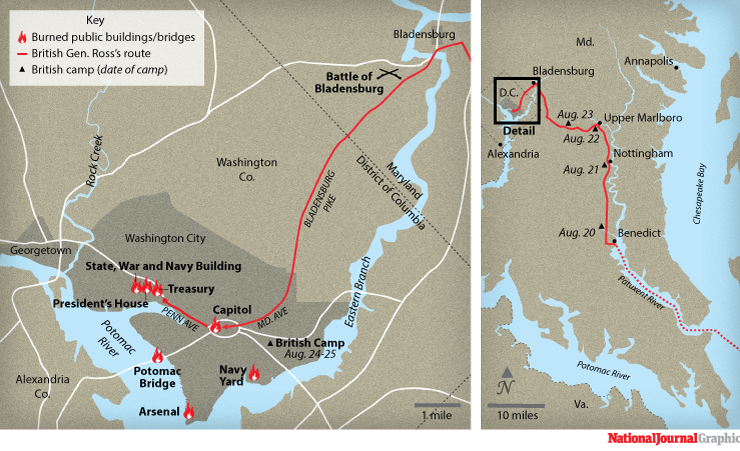
During the week of Aug. 20, 1814, British troops moved quickly up the Eastern Shore of Maryland, where they met little resistance. An American militia led by Brigadier Gen. William Winder, who little more than a year earlier was a Baltimore lawyer, gathered for a battle near the town of Bladensburg against a British force that included seasoned veterans of the Napoleonic wars. They quickly dispatched the poorly trained and ill-equipped American troops. By 8 p.m. on Aug. 24, the British had marched the five miles into Washington and were at the doorstep of the Capitol. Most citizens had deserted the city by this time, including President Madison.

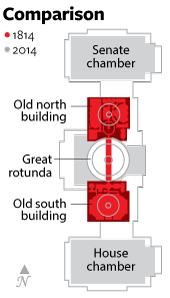
Once at the Capitol, the British split into two groups and entered from the east entrances. The building was still unfinished at the time; the iconic dome and rotunda had not yet been built. According to the architect of the Capitol, British soldiers focused on main rooms in the building, and spared the lobbies, hallways, and stairs they would need to escape.

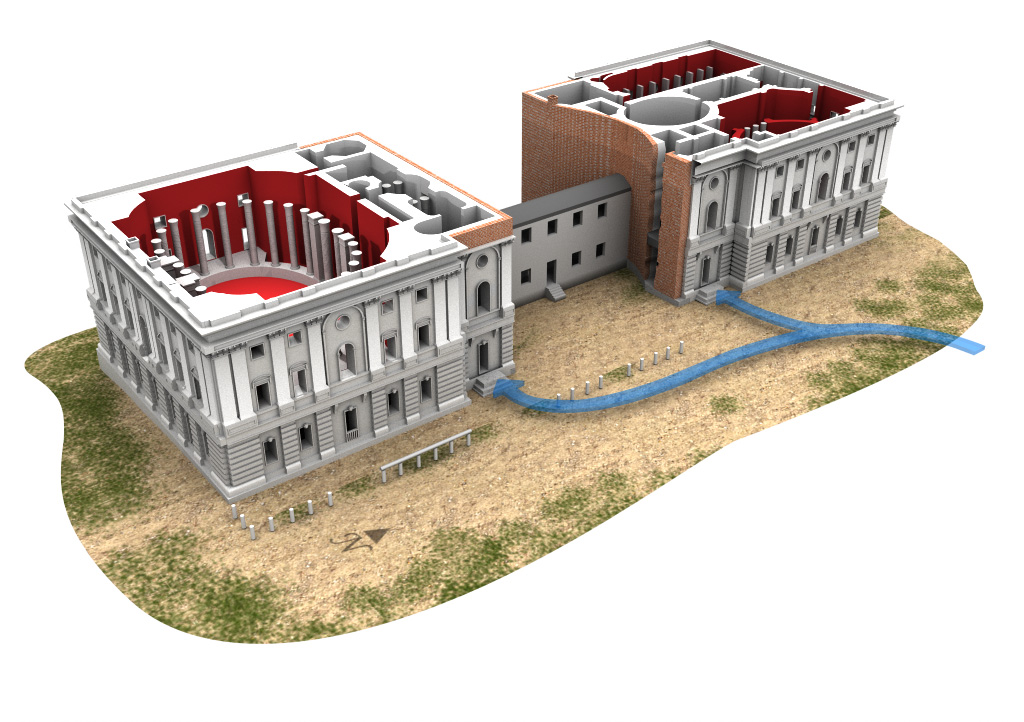
Burning of the Capitol Building

Rooms in RED were destroyed by fire. The BLUE arrows show the British troops' path.

Drag to spin the building
House of Representatives
chamber
Senate chamber
Library of Congress
Supreme Court
Temporary wooden walkway
British soldiers advance to the Capitol from Maryland Avenue NE

In the South Wing, soldiers barged into the House of Representatives chamber on the second floor. They gathered wooden furniture, placed it in a pile, slathered it with gunpowder paste, and lit the pile on fire. The fire was so hot that, with the exception of the clerk's office, most of the other offices in the South Wing were left without being lit ablaze by enemy soldiers.

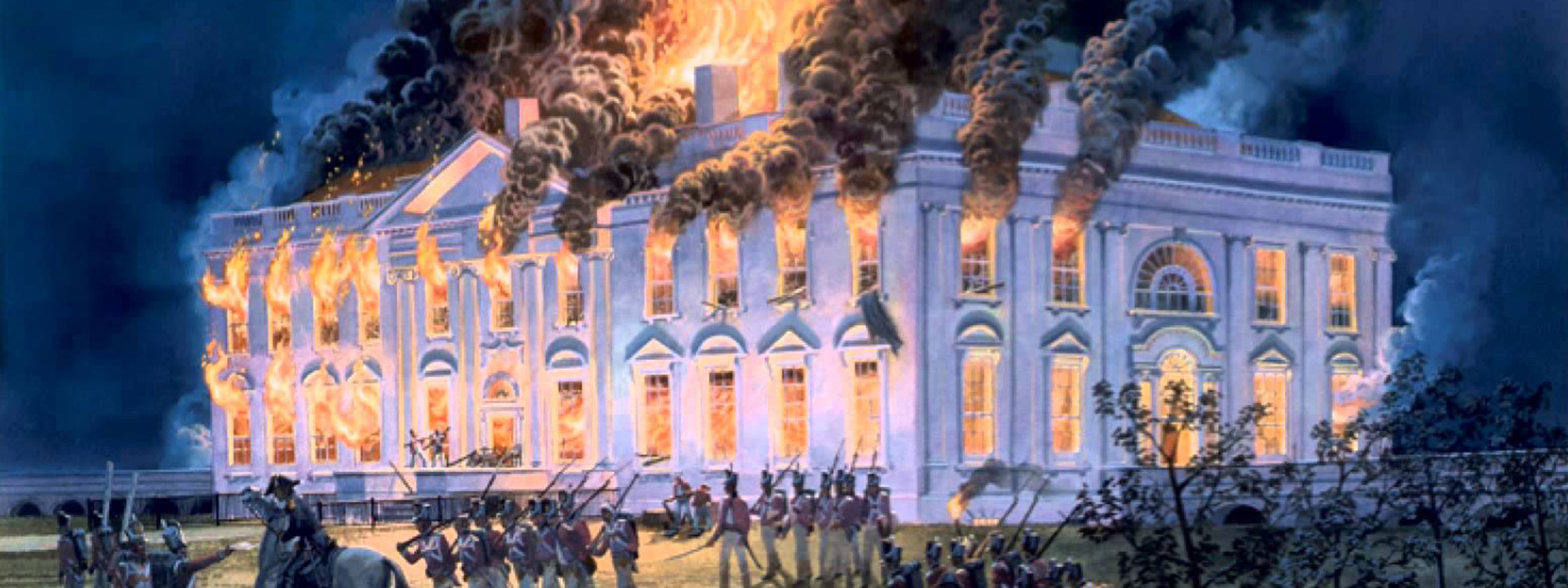
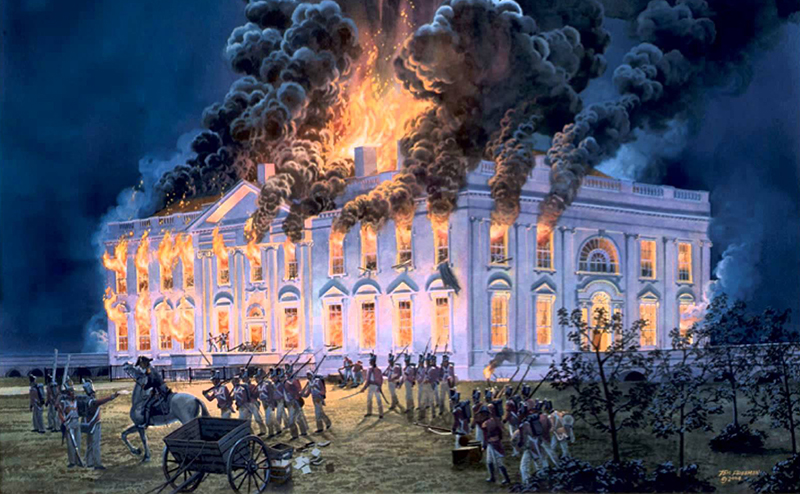
The North Wing at the time was home to the Senate chambers, the unfinished Library of Congress, and the Supreme Court on the first floor. All of the rooms were destroyed using materials from within, including the 3,000 books stored in the Library of Congress. Finally, the temporary wooden walkway between the Capitol's two wings was set ablaze and the soldiers moved on, marching northwest up Pennsylvania Avenue to destroy other government buildings, including the president's residence, now called the White House.

Damage was severe within the major rooms but the structure of both wings remained intact, thanks to fireproof materials such as marble, sandstone, zinc, copper, and iron used by architect Benjamin Henry Latrobe. Two centuries later, architecture that survived the fire, such as the "water leaves columns" in the Small House Rotunda and "corn cob" columns near the original entrance of the North Wing, are still visible.

Note: Capitol model based from the sketches and blueprints of architect Benjamin Henry Latrobe in 1808 and by a painting created by George Munger shortly after the fire in 1814. Sources: Architect of the Capitol; Library of Congress; National Archives; U.S. House; U.S. Navy